Examples
Intellectual Property Examples That Actually Built Moats (And What You Can Learn From Each One)
See 10 real intellectual property examples from successful tech startups and learn what made each one defensible — and how you can protect yours fast.
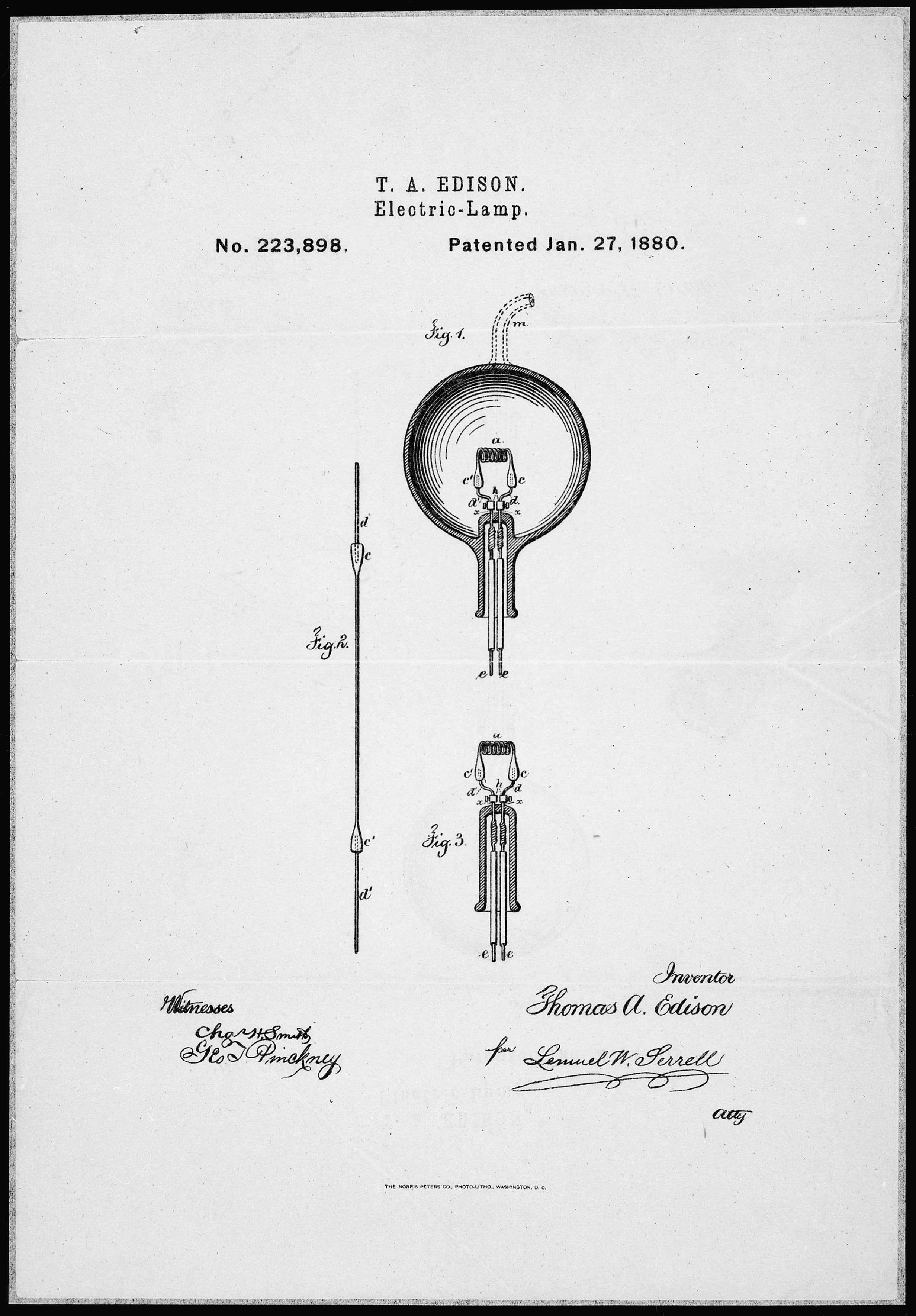
Exhibit A — 1880
The patent that lit the world.
Edison didn't invent the idea of an incandescent lamp — he filed the drawing that defined the durable, manufacturable version. The priority date on this sheet is what turned a workshop experiment into a global utility. Every founder filing today is doing the same kind of work, on a faster clock.
Most founders know intellectual property matters. Very few know why specific IP became a competitive weapon — or how fast they need to move to claim the same advantage. These 10 intellectual property examples from successful tech startups are not trivia. They are a playbook.
What Are Intellectual Property Rights, Really?
Before the examples: intellectual property rights are the legal mechanisms that let you own an idea's commercial expression. Intellectual property law recognizes four main types of intellectual property — patents, trademarks, copyrights, and trade secrets — and each one protects something different.
- Patents protect novel inventions and processes
- Trademarks protect brand identifiers (names, logos, sounds)
- Copyrights protect original creative works, including software code
- Trade secrets protect confidential business information that gives you an edge
Knowing the types of intellectual property is step one. Knowing which type to file, and when, is where intellectual property strategy separates founders who build moats from founders who build features.
10 Intellectual Property Examples From Tech Startups
1. Amazon's 1-Click Patent
Amazon filed a patent in 1997 for a single-click purchasing process. It sounds almost laughably simple today. But that patent locked competitors — including Apple, who licensed it — out of the most frictionless checkout experience on the internet for nearly 20 years. The lesson: the defensible thing was not the technology. It was the user experience process wrapped in patent protection before anyone else thought to file.
2. Google's PageRank Algorithm
Before Google was a verb, it was a patent. The PageRank algorithm — the core of Google's search ranking — was filed as a patent by Stanford University in 1998 and licensed exclusively to Google. This single piece of intellectual property protection gave Google a runway to build billion-user scale infrastructure without a direct technical clone threatening its core. Your AI-native workflow might have a similarly protectable core process.
3. Twitter's "Pull to Refresh" Gesture
Loren Brichter, who built the Tweetie app, invented the pull-to-refresh gesture. Twitter acquired the app and the patent. Today that gesture is everywhere — but Twitter held the intellectual property rights long enough to establish it as a UX standard under their brand. Even a single interaction pattern can be patentable if it is novel and non-obvious.
4. Dropbox's Sync Architecture
Dropbox did not invent cloud storage. They patented a specific method of syncing files across devices efficiently. Their intellectual property strategy was not to own "the cloud" — it was to own a defensible slice of how data moves through it. This is the kind of IP that makes acquirers pay premiums and makes your tech stack investor-ready.
5. Slack's Notification Filtering System
Slack holds patents on how it filters, prioritizes, and surfaces notifications across channels. In a world where every enterprise tool is fighting for attention, owning the method of managing attention is a serious moat. This is an intellectual property example where the innovation is behavioral and algorithmic — not hardware, not a physical product.
6. Zoom's Video Compression Method
Zoom's early patent filings covered specific methods of compressing and transmitting video data with lower latency. When COVID-19 forced the world onto video calls overnight, Zoom's IP position meant competitors could not simply copy their core performance advantage. Speed-to-market matters — but a priority date on your core method matters more when the market finally arrives.
7. Robinhood's Fractional Share Trading System
Robinhood patented methods for enabling fractional share trading — letting users buy $5 of Amazon stock instead of one full share. The intellectual property protection here was not on the concept of fractional ownership (that existed). It was on the specific system architecture that made it deployable at scale for retail users. The TAM for commission-free investing was always there. The IP made Robinhood the one who captured it.
8. Canva's Design Template Engine
Canva's intellectual property includes patents on how its template system dynamically adapts design elements to user inputs — essentially, an early form of what we now call generative app development applied to graphic design. Their copyright portfolio on template assets, combined with process patents, created layered intellectual property protection that is extremely hard to replicate cheaply.
9. OpenAI's Fine-Tuning Methods
OpenAI holds patents and trade secrets around specific methods of fine-tuning large language models on domain-specific data. The underlying transformer architecture is widely published — but the how of making it perform reliably in production is where IP lives. If your startup is built on prompt engineering or natural language interfaces, the defensible layer is often the method, not the model.
10. Stripe's Payment Tokenization Process
Stripe's intellectual property strategy centers on patents covering how it tokenizes payment data to reduce fraud exposure while maintaining transaction speed. This is a full-stack intellectual property example: they protected the frontend developer experience and the backend security architecture. The result is an IP portfolio that makes Stripe extraordinarily difficult to displace even when competitors offer lower fees.
What Made Each One Defensible?
Look across all 10 intellectual property examples and a pattern emerges:
- They filed early. Priority date is everything in intellectual property law. The first to file owns the right, not the first to build.
- They protected process, not just product. The defensible IP was rarely the thing users saw. It was the method underneath.
- They layered protection types. Patents plus trademarks plus trade secrets create compounding moats.
- They matched IP strategy to TAM. The bigger the total addressable market, the more aggressively they filed.
Your Intellectual Property Strategy Starts With a Priority Date
Here is the urgency most founders miss: in the United States, intellectual property law operates on a first-to-file system. The moment you share your idea publicly — in a pitch, a demo, a social post — your clock starts. You have 12 months to file a provisional patent application before you lose the right to patent that disclosure.
Vibe coding has made it possible to go from idea to working prototype in days. That is extraordinary. But building fast without filing fast means you are handing your moat to whoever files first.
If you are an early-stage founder who has been moving fast and has not thought seriously about intellectual property protection, this is the moment to stop and act. Join the workshop at Opportunisee to learn how to identify your defensible IP, file a provisional patent application, and make your startup investor-ready — without needing a law degree or a $50,000 legal retainer.
The Bottom Line on Intellectual Property Examples
Every company on this list started as a startup with an idea and a filing. None of them waited until they were big to think about intellectual property rights. They built fast and filed fast — and that combination is what turned features into moats and startups into market leaders.
You are building in the most powerful technological moment in history. AI-native tools, generative app development, and natural language interfaces mean the barrier to building has never been lower. The barrier to owning what you build is just as low — if you move now.
Start with the Opportunisee workshop and leave with a clear intellectual property strategy, a provisional patent framework, and the confidence that what you are building is actually yours.
The Opportunisee Workshop
Get the founder IP framework before you ship.
Join the mailing list to get the next cohort details, the provisional patent template, and the deployable IP checklist for vibe-coding founders.
Or visit the workshop directly → opportunisee.com/workshop
Keep reading
Pillar
What Are Intellectual Property Rights for Startups?
What are intellectual property rights and why do they matter for founders? Learn patents, trade secrets, and IP strategy before your next investor pitch.
IP Law
Intellectual Property Law for Startups: 4 Types Explained
Understand intellectual property law fast. Learn the 4 types of IP, which ones protect your software startup, and how to file before your competition does.
IP Rights
Intellectual Property Rights for Startups: A Founder's Guide
Understand intellectual property rights before your competitor files first. Learn when to file, what to protect, and exactly what it costs as an early-stage founder.
4 Types of IP
What Are the 4 Types of Intellectual Property for Startups
What are the 4 types of intellectual property? Learn patents, trademarks, copyrights, and trade secrets — and which ones protect your startup right now.